Brilliant code isn't enough in enterprise. Power dynamics, social capital, and knowing when to dive into problems others avoid matter as much as technical skill.
The Social Capital Framework
Social capital operates as professional currency that enables greater autonomy and influence. It accumulates through consistent delivery, strategic relationship building, and demonstrating sound judgement over time.
Social capital allows you to take calculated risks that others cannot. It's the difference between being told "no" and being trusted to make the right call, even when the stakes are high.
The most effective professionals understand that technical skills alone are insufficient. Success requires navigating the human systems that determine project allocation, resource access, and decision-making authority.
The 50-20-30 Rule
Here's something most people won't tell you: 50% of success is simply showing up. Not just physically being there, but being present, engaged, and ready to tackle whatever comes your way. The remaining breakdown: 30% is planning and understanding the terrain, and the final 20% is execution and feedback.
This might sound overly simplistic, but brilliant engineers fail because they can't master the "showing up" part. They disappear into their code caves, emerge with perfect solutions, then wonder why their work didn't get the recognition it deserved.
Visibility and engagement matter as much as technical competence. You need to be in the room where decisions happen, not just the room where code gets written.
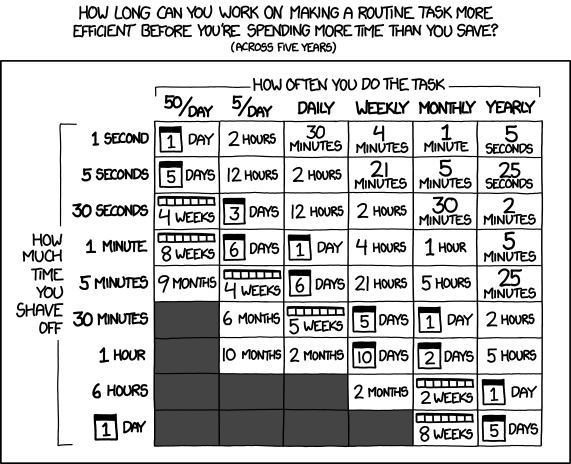
Is It Worth the Time? by Randall Munroe, CC BY-NC 2.5, via xkcd.
Strategic Onboarding: The Archaeology Approach
When starting somewhere new, most people waste the grace period by trying to ship something quickly to prove themselves. The alternative: use it to build a mental map of the technical and social systems.
System Mapping: Understanding data flows, architectural decisions, and the reasoning behind technical choices. Ask "why" questions about every system you encounter.
Cultural Intelligence: Observing how problems get approached, what communication patterns exist, and which behaviours are rewarded or discouraged.
Relationship Reconnaissance: Identifying who influences decisions, who has deep technical knowledge, and who serves as cultural bridges between teams.
There's always a grace period when you're new where expectations are minimal. The delayed gratification is worth it. The context you gain pays dividends for months afterwards.
Identifying High Performers
High-impact individuals typically exhibit several characteristics:
- Technical Excellence: Their code and architectural decisions demonstrate clear thinking and deep understanding
- Influence Patterns: Others seek their input on technical decisions and strategic direction
- Core Proximity: They work close to fundamental systems that drive business value
- Reputation Consistency: Their actual contributions match their internal reputation
Some individuals accumulate reputation through visibility rather than substance. Look for concrete evidence of impact rather than relying solely on others' opinions.
Once you've identified genuine high performers:
- Study their communication patterns and how they frame problems
- Analyse their technical approaches and decision-making frameworks
- Understand which projects they choose and why
- Observe how they build consensus and navigate disagreement
Embracing the Boring Bits
Here's where the advice diverges from typical career guidance: actively seek out the boring work. Documentation, incident response, training materials, cleanup tasks that everyone else avoids - dive in headfirst.
Why? Because these are often the tasks that create the most value but get the least recognition. When you're the person who consistently handles the unglamorous but critical work, you become indispensable. You also gain deep insights into how systems actually work, not just how they're supposed to work.
Plus, there's creativity to be found even in the mundane. Writing good documentation is a design challenge. Incident response requires detective skills. Training materials need storytelling ability.
The 80/20 Career Principle
Focus intensively on the 20% of activities that generate 80% of career advancement:
- High-Visibility Problem Solving: Tackling issues that matter to leadership
- Cross-Team Collaboration: Building bridges between traditionally separate groups
- Knowledge Creation: Developing expertise that others depend upon
- Cultural Contribution: Helping establish positive team dynamics and practices
Months 1-3: Foundation Building
- Week 1-2: Maximise learning during grace period
- Week 3-8: Demonstrate competence while continuing to map systems and relationships
- Week 9-12: Begin contributing to larger initiatives and offering strategic input
Months 4-12: Influence Development
- Quarter 2: Lead smaller projects and mentor newer team members
- Quarter 3: Contribute to architectural decisions and cross-team initiatives
- Quarter 4: Establish yourself as a go-to person for specific domains
Sustainable Performance
The fastest path to influence often involves working excessively long hours, but this creates several risks:
- Expectation Inflation: Others begin expecting unsustainable performance as your baseline
- Project Pigeonholing: You may get assigned to lengthy, less visible projects
- Perceptual Velocity Problems: Long projects can make you appear slower despite delivering significant value
Avoid becoming so focused on advancement that you neglect the human elements of work. The goal is sustainable influence that benefits both you and your colleagues, not manipulation that creates enemies.
Key Success Indicators
You know you're developing competitive advantage when:
- Project Choice: You're consulted about which projects you'd prefer to work on
- Technical Authority: Others seek your input on architectural and technical decisions
- Cross-Functional Influence: Product and business stakeholders value your perspective
- Autonomy Increase: You're given more discretion in how you approach problems
- Mentorship Opportunities: Junior colleagues seek your guidance and leadership wants you developing others
The ultimate measure is reaching a position where you can focus your efforts on work that genuinely matters to you while contributing meaningfully to company success.
Summary
- 50% of success is showing up. Present, engaged, ready.
- Use the grace period wisely. Map systems and relationships before shipping.
- Build social capital. Consistent delivery + strategic relationships + sound judgement.
- Seek the boring work. It creates the most value and teaches you the most.
- Focus on the 20%. High-visibility problems, cross-team collaboration, knowledge creation.
- Sustainable over flashy. Long-term influence beats short-term wins.
What's Next
If you're early in your career, focus on the fundamentals: show up consistently, dig deep into understanding context, and don't be afraid of the boring work. If you're more experienced, remember that your role isn't just to solve technical problems - it's to help others navigate the complexity of building software in large organisations.
Either way, remember that 50% of success is just showing up. The rest, you can figure out as you go.