Headlines say "DHH changed his mind on AI." That's not it.
His standards didn't change. His philosophy of craft didn't change. His suspicion of bad ergonomics didn't change. What changed is agent harnesses and stronger models got good enough to preserve taste while making more things feel economically possible to build.
New equilibrium. Code generation is cheaper. Judgement is not. Exploration is cheaper. Prioritisation is not. More people can draft implementation. Fewer can reliably decide what should merge, what should be cut, what's worth doing at all.
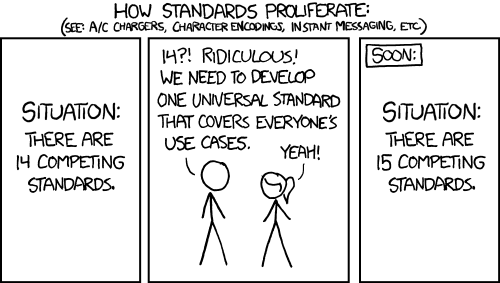
Standards by Randall Munroe, CC BY-NC 2.5, via xkcd.
The Inflection Point: Workflow + Model Quality
DHH's resistance wasn't mainly ideological. He found autocomplete hostile because it constantly interrupted thinking. Autocomplete tried to finish his sentence. Agent harnesses let him define work, hand it off, review the result.
The distinction between autocomplete and agents is the difference between interruption and delegation. Autocomplete suggests six lines while you're building a mental model. You stop thinking, evaluate the suggestion, decide it's wrong, dismiss it, reconstruct your train of thought. The interruption costs more than the suggestion saves.
Agents chunk the interaction differently. Intent, delegation, review. No interruptions mid-thought. The model quality threshold isn't about generating impressive code - it's about generating code that passes the merge test. Code that needs little or no alteration. Code that learns from corrections instead of repeating mistakes.
The inflection point isn't that the technology is new. It's that it finally became teachable.
This matters for adoption curves. Early autocomplete frustrated experienced engineers because it broke concentration without adding enough value. Agent harnesses flip the equation: they preserve concentration while adding significant value. The barrier to adoption drops sharply once the interaction design crosses this threshold.
Pre 2025:    AI feels important but coding UX is irritating
Early phase: Chat interfaces useful for tutoring
Mid phase:   Tab completion feels intrusive and low trust
Late 2025:   Agent harnesses become viable, terminal workflow clicks
Inflection:   Stronger models produce code worth reviewing and merging
2026:        Agent first becomes default for new work
- Distinguishes between believing tech matters and enjoying how it's used
- Autocomplete failed because it broke concentration, produced low-confidence noise
- Agent harnesses succeed because they enable chunked delegation, tool use, explicit review
- Model quality mattered only when it crossed the threshold of producing reviewable code
37signals Already Had the Shape AI Rewards
Most useful part of the conversation isn't about models. It's about how 37signals builds products.
Their designers aren't downstream spec-polishers. They help decide what to build, how it works, often implement HTML, CSS, and behaviour themselves. Early product teams are tiny - one programmer plus one or two designers - until the shape becomes clear.
AI rewards exactly this kind of organisation. When implementation gets cheaper, people who move fluidly between product judgement, interface design, and code become unusually powerful.
DHH's point isn't merely that designers should code. It's that people who understand the material they work in design better things. Architect benefits from understanding structure. Jeweller benefits from understanding metal.
AI makes this model more viable because the designer doesn't need to learn React or backend architecture to work in the actual medium. They can describe what they want, review what the agent produces, and iterate in the actual product. The boundary between design and implementation blurs when implementation becomes cheap.
The New Scarcity Stack
| Theme | DHH's Claim | Practical Implication |
|---|---|---|
| AI adoption | Philosophy didn't flip, tools got better | Re-evaluate workflows, not just models |
| Productivity | Big win is tackling previously uneconomic work | Use agents to widen ambition, not just shorten ticket time |
| Craft | Beauty, readability, coherent design still matter | Review becomes a first-class skill |
| Org design | Small teams and builder-designers gain leverage | Product and implementation boundaries blur |
| Career impact | Seniors benefit first because they validate output | Judgment-heavy roles gain, execution-only roles face pressure |
| Sustainability | Dopamine loop is real | Protect sleep and pacing or gains turn corrosive |
Gains Accrue Unevenly
Gains don't hit everyone equally. Senior engineers, designers who can implement, generalists who validate output become more leveraged first. Junior-heavy pipelines and execution-only roles look more fragile.
If implementation becomes cheap but validation becomes the scarce skill, then the people who can validate become disproportionately valuable. That's not a temporary distortion. That's a new equilibrium.
DHH is explicit that this acceleration is intoxicating enough to create burnout risk. The dopamine loop of rapid agentic output is real - the first week of serious agent use often produces more code than the previous month. The second week, velocity becomes addictive. The third week, the boundary between work and rest blurs because "the agent could finish this while I sleep." The productivity gain is real. The burnout risk is also real.
Summary
- DHH didn't flip on AI. He flipped on interaction design. Autocomplete intrusive; agents delegative.
- Merge test is the real threshold. Models matter when they produce code a high-bar reviewer might merge.
- Small teams and builder-designers win. When implementation is cheap, taste and judgement become scarce.
- Seniors benefit first. Validation and review skills become more valuable.
- Protect your pace. Dopamine loop of rapid agentic output is real and corrosive without boundaries.
What's Next
Next time you evaluate an AI coding tool, ask not just whether the model is good, but whether the interaction design preserves your ability to think. Strong model inside bad workflow can still be unusable for experienced engineers.